Using proxies is one of the most effective ways to bypass restrictions on the internet. They allow browsing the web privately and access to content and websites in regions where they are restricted. However, where you buy your proxies will have a significant impact on the overall experience you will have using them.
There are so many vendors out there that you can consider, each with its pros and cons that you need to be aware of before making your choice. In this guide, we will discuss everything you need to know before purchasing proxies, including the top six providers that you can consider. Without wasting any more of your time, let’s jump right in!
What Counts as a Premium Proxy in 2026
Not every proxy sold as “premium” earns the label. There are key factors that make a proxy premium. These include verified IP sourcing, consistent uptime, and geo-accuracy you can rely on for real workflows. It is also important to note that what was considered premium ten years ago, may not really earn that title today .
In 2026, the baseline expectation for a premium proxy includes at least 99%+ uptime, sub-second latency, large pool of clean IPs in all the major regions, and support for both HTTP/S and SOCKS5 protocols. Providers that meet these standards across residential, ISP, mobile, and datacenter types are what you should consider premium. It is also crucial to note that free proxies don’t meet all the above criteria. Stay away from these if you need a reliable and safe experience.
Key Criteria We Used to Shortlist Providers
If you intend to buy premium proxies from any provider, there are some key factors you must consider. Every provider on this list was evaluated against these same factors.
- IP pool quality and size: Clean, ethically sourced IPs with verified geo-coverage, not inflated counts from recycled or flagged addresses. For each proxy vendor, we provided the estimated number of IPs that are offered in the different countries to give you an idea of their IP pool size and coverage.
- Uptime and latency: Documented guarantees of 99%+ uptime and sub-1-second response times are what we recommend. For every provider on this list, we shared the uptime their guarantee and the response time — the two factors that affect proxy performance and reliability.
- Proxy type variety: We considered providers that support residential, ISP, and datacenter proxies at minimum. Having this variety allows users to make a choice based on the current needs.
- Geo-targeting depth: City-level targeting, not just country-level routing. This guide also assesses how well the providers cover the different regions, including if they include city-level targeting. This precise targeting is required for some use cases like SEO monitoring and Ad verification.
- Session control: A reliable provider should offer both rotating and sticky session options with configurable intervals. This flexibility allows users to choose the option that suits their needs. For instance static proxies are great for account management while rotating ones are a good option for data scraping.
- Pricing transparency: Clear per-GB or per-IP pricing with no hidden fees or forced enterprise tiers. We included the prices of each for the different proxy types.
- Support quality: Responsive channels and documentation that reduces setup friction. You need a provider that you can reach at any time on a convenient channel and expect to get feedback in a reasonable time frame.
Six Trusted Picks for Quality and Uptime
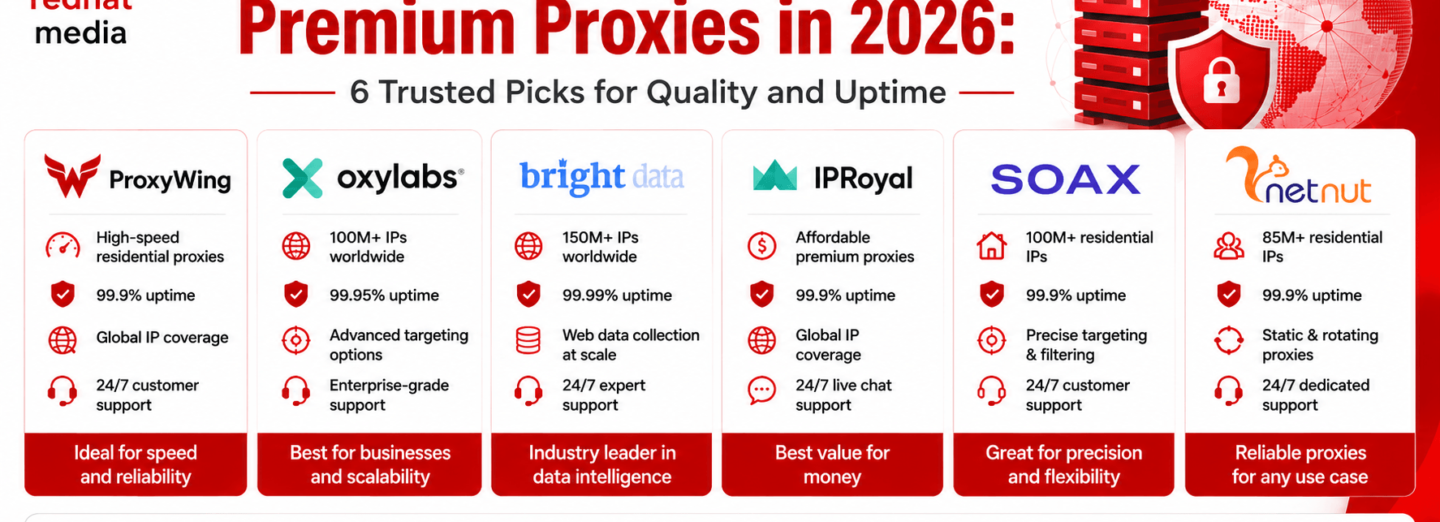
These are our top providers in 2026
1. ProxyWing — the strongest all-around pick for most users.
We have ProxyWing on top because it takes care of all the key factors that affect user experience. It offers 70M+ IPs across 190+ countries, city-level targeting, sub-1-second latency, 99.9% uptime, and unlimited ISP bandwidth.
It also offers all the major proxy types, including residential, ISP, mobile, and datacenter proxies are available with both rotating and sticky sessions. ProxyWing also has 24/7 support available via email, live chat, Discord, Telegram, and other major social media platforms.
Pricing
- Datacenter proxies: From $0.9/month
- Residential proxies: From $1.0/GB
- ISP proxies: From $1.7/month.
- Mobile proxies: From $4.0/day
2. Oxylabs — Built for enterprise scale.
If you need a provider that gives you access to a large IP pool to choose and handle your business proxy needs, Oxylabs is one of the best choices today. It offers over 177M+ IPs across 188+ countries with city-level targeting and advanced tooling including an AI-driven Web Unblocker, it handles high-concurrency workloads reliably.
It promises a 99.95% success rate and sub-0.7-second response times. Oxylabs also has a reliable support team that you can access via email, live chat, and the major social media sites.
Pricing
- Datacenter proxies: From $0.7/IP
- Residential proxies: From $2.5/GB
- ISP proxies: From $1.2/IP.
- Mobile proxies: From $3.5/GB
3. Bright Data — Best Scraping tools
It is known for offering some of the best built-in scraping tools. Bright Data has an IP pool with over 150M+ IP pool spanning 195+ countries with flexible rotation, a 0.6-second average response time, and city-level geo-targeting.
It also promises 99.99% uptime and a success rate above 99% across most platforms. Their support is available 24/7 and can be reached via WhatsApp, email, Telegram, and social media.
Pricing
- Datacenter proxies: From $0.9/IP
- Residential proxies: From $2.5/GB
- ISP proxies: From $1.3/IP
4. IPRoyal — Ideal for small teams and pay-as-you-go users.
IPRoyal is one of the providers that target small businesses and teams that need flexibility. Its non-expiring residential bandwidth and transparent pricing remove commitment pressure. It also integrates with 650+ tools and promises sub-200ms latency and 99.9% uptime.
It also offers a proxy pool of 32 million IPs in 195+ countries worldwide. When it comes to support, IPRoyal can be contacted via Live chat, email, Discord, and social media sites.
Pricing
- Datacenter proxies: From $1.39/Proxy
- Residential proxies: From $1.75/GB
- ISP proxies: From $2.0/Proxy.
- Mobile proxies: From $10.11/Day
5. SOAX — Granular session control with IP rotation
It offers proxy rotation intervals from 1 to 60 minutes and broad protocol support, including UDP and QUIC. SOAX also covers 195+ countries with 190M+ IPs, promises a 0.55-second response time, and city-level targeting. It promises 99.5% success rate and 99% uptime. Their support can be contacted via Live chat and LinkedIn.
Pricing
- Datacenter proxies: From $90/month for 145GB
- Residential proxies: From $90/month for 25GB
- Mobile proxies: From $90/month for 25GB
6. NetNut
It uses an ISP-direct, single-hop architecture that delivers stable, fast sessions. It offers a pool of over 90M IPs that covers 195+ countries with city-level targeting and sticky sessions up to two hours. NetNut promises 99.9% success rate, 99.99& uptime, and 24/7 support that can be contacted via live chat, email, Telegram, Discord, and major social media sites.
Pricing
- Residential proxies: From $99/month for 28GB
- ISP (static residential) proxies: $84/month for 7GB
- Mobile proxies: From $85/month 13GB
- Datacenter proxies: From $90 for 100GB
Pricing Models You’ll Encounter Across the Six
These providers use three main pricing structures:
- Per-GB (bandwidth-based): Common for residential and mobile proxies. You pay for data consumed, not IPs used.
- Per-IP: Standard for ISP and datacenter proxies. You pay per IP address, often with unlimited bandwidth attached, especially for datacenter proxies.
- Monthly subscription: A flat monthly fee covering a set data or IP allowance. ProxyWing is among the providers that uses this model.
Some providers combine models depending on proxy type. Before choosing a provider, you need to confirm the pricing structure for the specific proxy type you need.
Red Flags to Watch For Before You Pay
- No verifiable IP count for your target country: Vague claims like “global coverage” without specific pool data often mean thin or shared infrastructure. Not ideal for reliability and precise geo-targeting.
- No sticky session support: Any provider lacking sticky sessions is unsuitable for login-dependent tasks such as account management.
- Uptime guarantees below 99%: Sub-99% uptime is a sign of unreliable infrastructure that will hurt automated workflows. You won’t have stable connections with their proxies.
- Opaque pricing or forced sales calls: Providers that hide pricing behind demo requests typically charge enterprise rates with no flexibility for smaller users.
- No protocol options beyond HTTP: Missing SOCKS5 support limits compatibility with most automation tools and scripts.
- No refund policy or free trial: Reputable providers let you test before committing. Skipping this step risks paying for a pool that doesn’t work for your use case.
Final Thoughts
The proxy industry in 2026 is more robust than ever. However, choosing the right provider is the most important step to getting a great experience. Among all the providers covered in this guide,
ProxyWing covers the widest range of needs at the best price point, which makes it a great choice for a wide range of use cases, including automation, scraping, and geo-targeted workflows.
Oxylabs and Bright Data are worth the premium if you’re operating at enterprise scale. IPRoyal and SOAX are solid mid-range options for flexible or budget-conscious users. NetNut suits teams that need session stability above any other factor. But regardless of your use case, prioritize verified geo-coverage, documented uptime, and transparent pricing over marketing claims.
Leave a Reply